
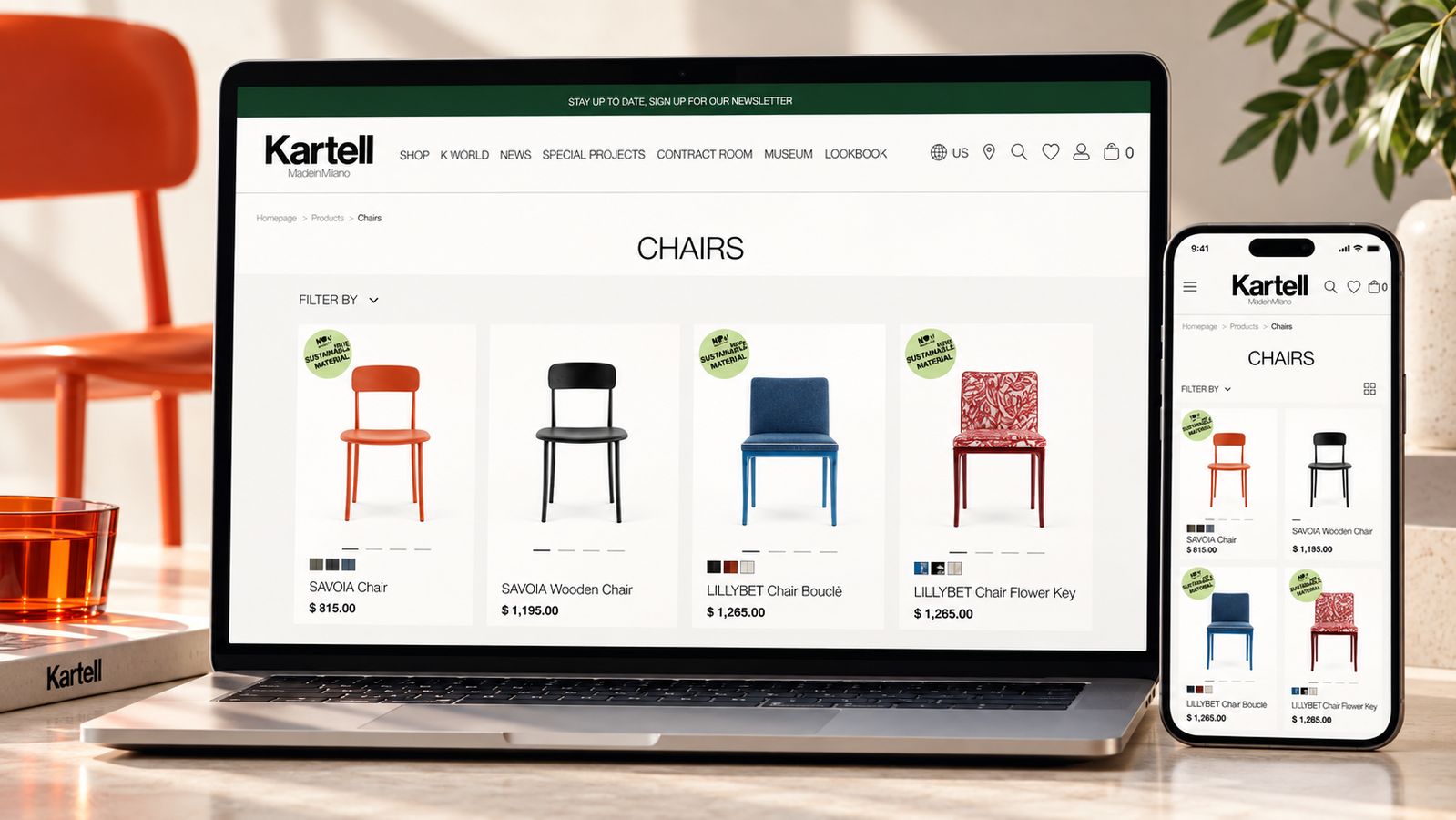
E-commerce in the United States is no longer a supporting channel. In 2026, it operates as core infrastructure for sales, product discovery, and customer relationships. The opportunity keeps expanding, but the market has also become more demanding: launching an online store is easy; building a profitable channel requires strategy, user experience, acquisition, content, and operations working as one system.
The U.S. market continues to expand
According to the U.S. Census Bureau, seasonally adjusted retail e-commerce sales reached $340.2 billion in the second quarter of 2026. That represents 12.2% growth compared with the same period in 2025, while total retail sales grew 6.7%.
The most important signal is not size alone. E-commerce represented 17.1% of all retail sales during the quarter, compared with 16.4% for full-year 2025. Digital commerce continues to gain share even from an annual base already above one trillion dollars.
In 2025, U.S. retail e-commerce generated $1.2337 trillion. Annualizing the second-quarter 2026 level would place the market around $1.36 trillion. That figure is a scale reference based on the quarterly pace, rather than an official year-end forecast.
Looking further ahead, Forrester projects U.S. online retail sales will reach $1.6 trillion by 2028 and represent 28% of retail under its methodology. Definitions vary between sources, but the direction is consistent: more spending and a larger share of business moving through digital experiences.
Consumers are not only buying more—they are buying differently
During the 2025 holiday season, Adobe Analytics recorded $257.8 billion in U.S. online spending, up 6.8% year over year. Smartphones generated 56.4% of those sales, confirming that mobile is no longer a secondary screen.
Product discovery is changing too. Adobe reported a 693.4% increase in traffic referred from generative AI tools to retail sites during the holiday season. Traditional search remains important, but it now sits alongside social platforms, marketplaces, creators, retail media, and AI assistants.
For brands, this changes the starting point. An online store cannot be designed desktop-first or rely on one traffic source. The purchase journey begins well before the product page and often crosses several platforms before conversion.
How much can a brand sell through e-commerce?
There is no universal answer. Revenue depends on demand, pricing, traffic, conversion rate, purchase frequency, inventory availability, and fulfillment capacity. A useful way to estimate the opportunity is with a simple equation:
Monthly traffic × conversion rate × average order value = monthly revenue
Three illustrative scenarios show the potential scale:
- 25,000 monthly visits × 1.5% conversion × $75 average order value = $28,125 per month, or approximately $337,500 per year.
- 100,000 monthly visits × 2% conversion × $90 average order value = $180,000 per month, or $2.16 million per year.
- 500,000 monthly visits × 2.5% conversion × $110 average order value = $1.375 million per month, or $16.5 million per year.
These examples are not forecasts or guarantees. They show how modest improvements across traffic, conversion, and order value can create substantial differences. They also explain why a brand should never judge its e-commerce operation by store design alone.
The most valuable opportunity: building an owned asset
Marketplaces can accelerate reach, but a direct channel gives the brand control over the relationship: behavioral data, purchase history, preferences, post-purchase service, and repeat sales.
That asset becomes more valuable when e-commerce connects with content, CRM, email, SMS, paid media, inventory, and customer service. Each interaction can improve the next one and reduce dependence on isolated campaigns.
Brands with the strongest opportunity in 2026 usually share four conditions:
- A product with a clear proposition and enough margin to support acquisition, fulfillment, and returns.
- A fast, simple, trustworthy mobile experience from discovery through checkout.
- Content that answers real questions and makes products visible across search, social, and AI systems.
- A retention strategy that increases repeat purchases and customer lifetime value.
Social commerce: social platforms are sales channels too
In 2026, social platforms do more than build awareness. Instagram, TikTok, Pinterest, YouTube, and creator ecosystems shape discovery, consideration, and conversion. For many brands, the first interaction with a product happens inside a short video, recommendation, or social search before the customer ever visits the store.
Social commerce reduces the distance between inspiration and purchase. Connected catalogs, product tags, platform storefronts, live shopping, direct links, and user-generated content can turn every post into a potential entry point to the e-commerce experience.
The opportunity grows when social connects with the full commercial operation:
- Organic content that demonstrates the product, answers objections, and builds trust.
- Creators and customers who provide social proof in formats native to each platform.
- Paid campaigns that amplify the strongest creative and attract qualified audiences.
- Dynamic retargeting that brings back product viewers and abandoned carts.
- CRM, email, and SMS that continue the relationship after the click and encourage repeat purchases.
Social should not be measured only through follower count or engagement. A mature strategy connects content with qualified visits, product views, initiated checkouts, assisted sales, and customer value. That turns social from a publishing calendar into an active layer of the revenue system.
Each platform should have a defined role. TikTok and Reels can accelerate discovery; Instagram can connect brand identity, consideration, and catalog; YouTube can explain higher-involvement decisions; creators and customer content can reduce perceived risk. The right mix depends on the product, its price, and audience behavior.
Growth is not enough—the channel must be profitable
Revenue growth can hide high costs. The primary metric should never be revenue alone. A healthy operation monitors contribution margin, customer acquisition cost, conversion rate, average order value, repeat purchases, returns, and fulfillment costs together.
The right question is not simply “How much can we sell?” It is “How much can we sell sustainably, and which levers improve profitability?” A campaign can increase traffic within days; improving the offer, checkout, or retention can transform the economics of the business for years.
What brands should prioritize in 2026
- Design mobile-first from the first wireframe. More than half of online spending can already come from smartphones during high-demand periods.
- Remove friction. Speed, payment options, visible shipping costs, and a short checkout directly affect conversion.
- Build demand and capture it. Content, SEO, paid media, creators, and CRM should operate as parts of one journey.
- Prepare the catalog for new discovery engines. Product information must be clear, structured, and useful to search engines and AI assistants.
- Measure profitability by product and channel. Scale what generates margin, rather than clicks or gross revenue alone.
- Treat repeat purchase as part of the product. Packaging, support, automation, and loyalty programs shape lifetime value.
2026 is a strong moment to build, not improvise
U.S. e-commerce continues to grow faster than retail overall, and consumers have made digital purchasing part of everyday life. The opportunity is significant, but it is not automatic. The market rewards brands that combine a relevant proposition, a frictionless experience, and an operation capable of delivering on the promise.
For a brand that still depends on physical sales, distributors, or phone support, digital commerce can unlock a new source of revenue and customer data. For a brand already selling online, the opportunity lies in improving conversion, retention, and efficiency. In both cases, e-commerce should be designed as a complete growth system.
Sources
U.S. Census Bureau — Quarterly Retail E-Commerce Sales, Q2 2026
U.S. Census Bureau — Quarterly Retail E-Commerce Sales, Q4 2025